
The Knitted Socks

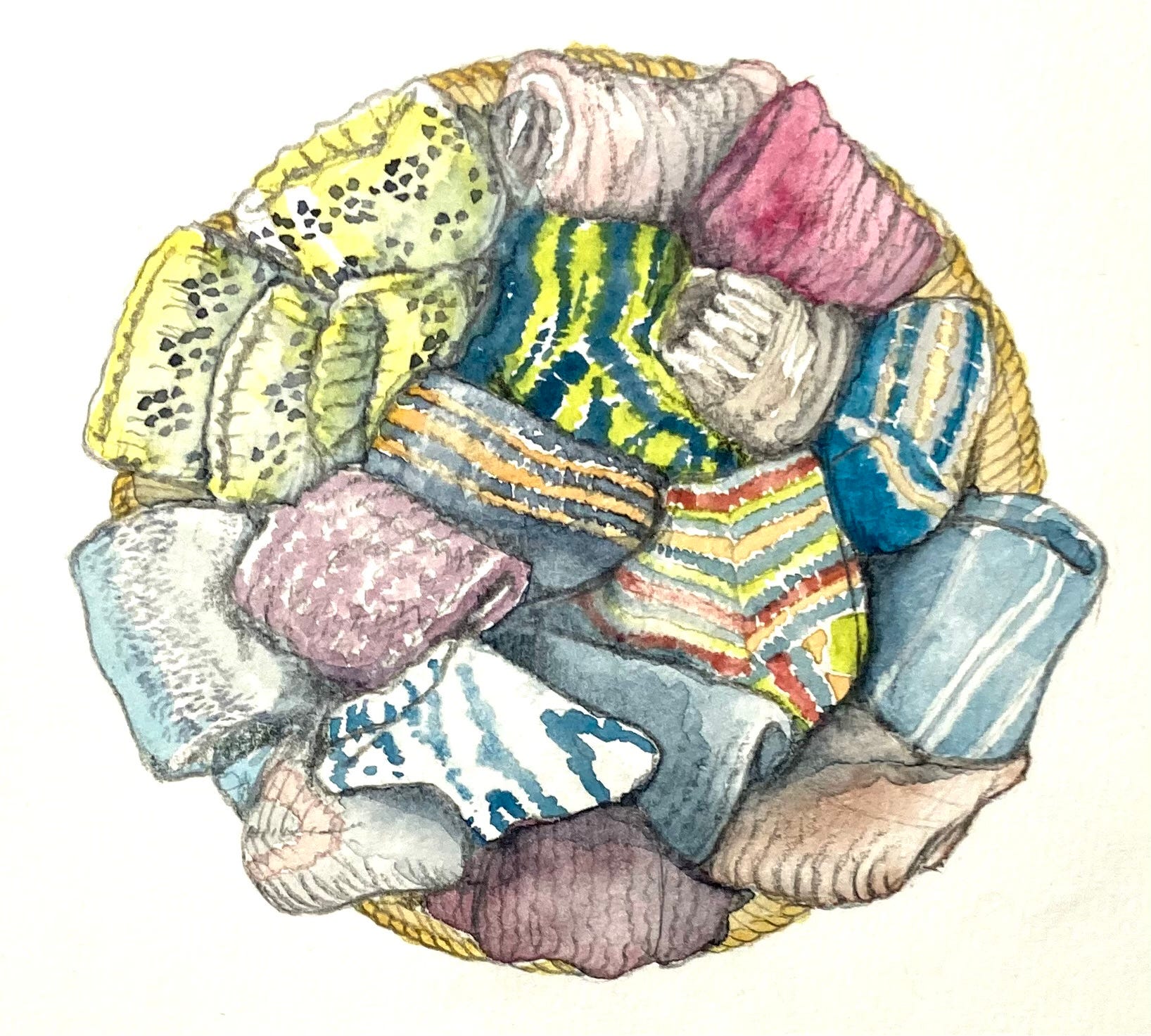
The Knitted Socks
Chicago, Illinois
2005
Standing in the garden, I balanced a flute of champagne in one hand, a little plate of nibbles in the other. Servers in white shirts and black ties carried trays with hors d’oeuvres and wine. Sun sifted through lush foliage set rippling and murmuring in the evening breeze. Petrichor, the earthy scent of freshly fallen rain, filled the air. Conversations drifted among newly hired faculty destined to know one another well.
My social skills had never been a bankable commodity. I shifted side to side and stared down with undue interest in a flowering shrub.
The university president walked over and placed one hand on my shoulder, her other hand on the woman standing quietly beside me. “You two need to get to know each other,” she said. We were both Susans. Other Susan wore a simple sweater outfit and a wash-and-wear hairstyle. Our exact conversation is lost to memory, but it would have been like this:
“What will you be teaching?” asked Other Susan.
“The liberal arts core in fashion design and merchandising,” I said. “I moved here from Colorado.” My mind’s eye flashed on places I had left behind—Rocky Mountain National Park, Horsetooth Reservoir, Pawnee Grasslands, Red Feather Lakes—for my move to a great city in the Midwest.
“And you?”
“I’m the new Dean of the College of Library and Information Science. I was with the American Library Association in the city. I live in LaGrange. Easier commute now.” She smiled.
“I’ll be spending a lot of time in libraries,” I told her. Back in February, I had signed a contract for this tenure-track position at a teaching-intensive university and a contract to write a book—70,000 words and 350 images—on the cultural history of American knitting. “Somehow, I will develop six new courses and research a book this year.”
On one hand, what was I thinking?
On the other hand, how could I have said no to either opportunity?
“I’m a knitter,” said Other Susan. “A pretty serious knitter.”
“Really?”
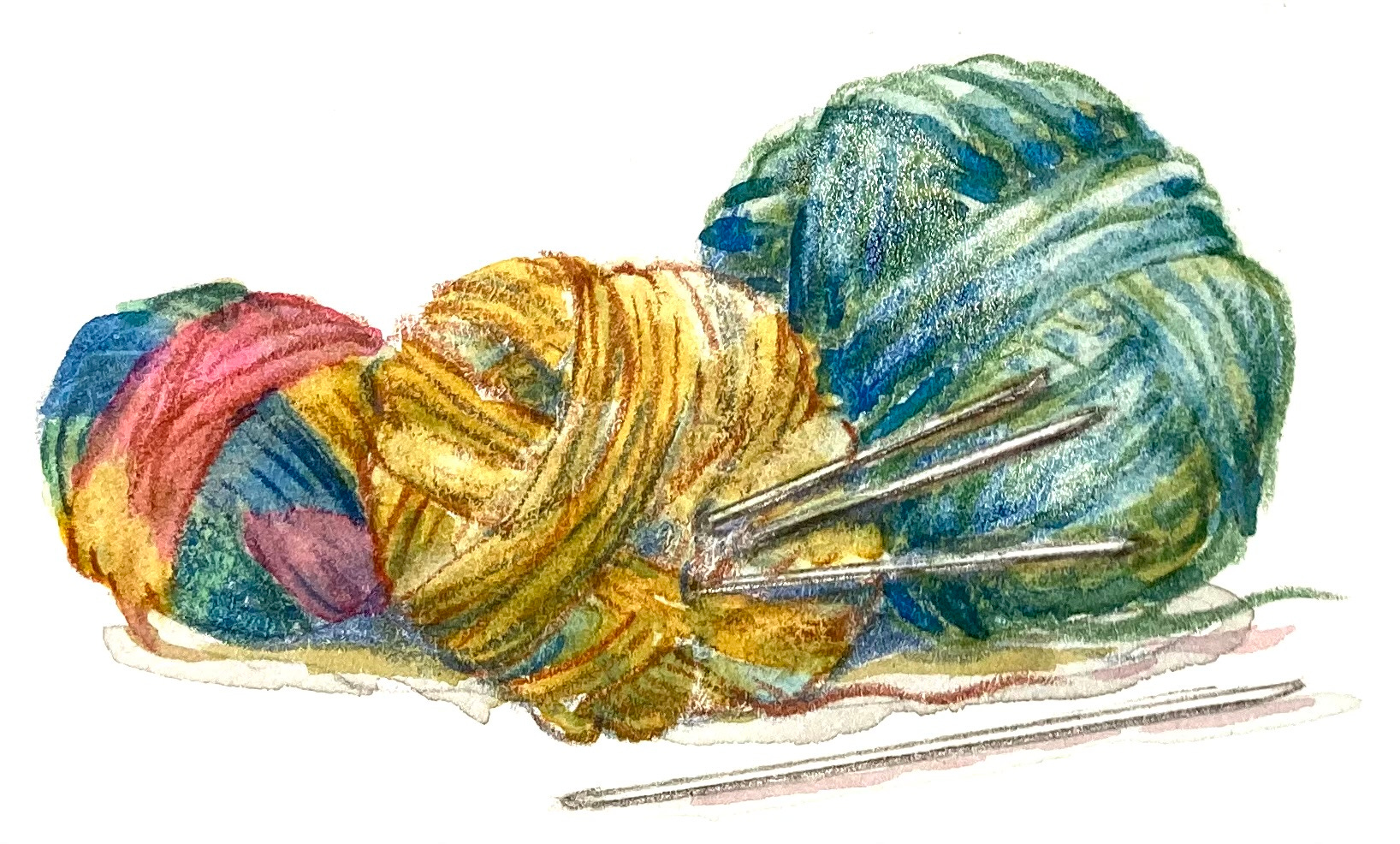
We talked about knitting and yarn, libraries and library resources about knitting. My first friend in this new place. Yarn and knitting drew us together.
Odd the way that this position at a small, private university had opened only days after my major advisor slipped the doctoral hood over my shoulders at commencement. I was familiar with Chicago. Cousins lived in the suburbs, and my son was a University of Chicago graduate. I had returned to doctoral studies with no interest in teaching. I studied historic and ethnographic textiles wanting to travel, research, and write about textiles. Professors in my graduate program understood that university teaching would be my most practical choice and prepared me for the academic world anyway.
My academic life had begun in a garden, a place of growth and enclosure, safety and welcome.
And then it all started to fall apart.
My office space was a desk in the department chair’s office. She had no indoor voice. I was expected to leave during sensitive phone and in-person meetings. In an old building with no air conditioning, indoor temperatures hovered at 90 degrees during my first month on campus.
I was taken aback when a colleague took me aside and warned me, quietly, to avoid certain faculty and administrators—he named names—said to have driven people out. Wow.
My classes were scheduled for 8:30AM and 3:30PM—times when students were barely awake—on Mondays, Tuesdays, Wednesdays, Thursdays and from 8:30 to 12:30 on Friday mornings. A scheduler somewhere kept me off kilter and reassigned my classes to different rooms around campus, and internet connectivity varied. In the rustic textile science lab, sinks did not drain. Hurriedly, I courted the maintenance and computer support folks.
My classes were small, never more than twenty students. Still, I walked into each class feeling terribly anxious, deep-breathing-so-I-could-cope anxious. I prepared over the top for every class. Clutching my meticulous script, I clicked through PowerPoint slides designed to pause for online live links and examination of actual textiles. (YouTube launched in December 2005.) I developed each course—textile science, dress and culture, social psychology of dress, two semesters of history of dress, surface design of fabric—with peer-reviewed readings and the online management system. Before I arrived, adjunct educators taught with slide carousels and printed syllabi. Students adjusted. I never asked them to work harder than I did.
And yet the loneliness of academic life took me by surprise. Writing syllabi and exams, designing lectures and assignments, grading papers, preparing publications and presentations were alone-in-the-office-with-the-door-closed-so-you-could-concentrate solitary pursuits. Without a proper office, I worked wherever I found space in the library.
After my first month on campus, exhausted, I stared at a stack of textile science quizzes waiting to be graded and asked myself, What would happen if I just didn’t come back tomorrow? How could I make a living? At my desk, I wrote a plan for a knitting cat-sitter business in the Pacific Northwest. Or cat-sitting knitter. Whatever. (Aunt Marie, my godmother, once told me, “Do pet sitting if you ever need money.”)
This would not do.
I walked to my car and phoned a mentor, a professor familiar with academic frustration.
She listened. Empathized. “Okay, here’s what you do,” she said.
“You teach your classes, keep office hours, attend committees. You be polite to everyone, even those annoying people who are pills.”
I grabbed a pen and notebook from my bag of ungraded papers.
“Take the long view,” she said. “What does the university as a whole offer you?”
I balanced my notebook on the steering wheel and scribbled notes.
“Watch for ways to study abroad and collaborate across disciplines. If there’s travel funding for professional meetings, go for it. Check out requirements for sabbatical leave and course releases for research and writing. If there’s tuition remission, you can take classes. Academe can be a good life. You can do this.”
“I hear you,” I said. I never looked back.
The knitting cat-sitter disappeared into the ether. I made peace with teaching and university life, mostly.
A Catholic college built in 1901, the campus put me in mind of an abbey. I pictured earlier decades of Sisters in white habits floating across campus and down corridors, dark and wide, to classrooms with tidy young women wearing dresses. During the 1970s, economic hardship brought male students into the fold and the college grew into a university. The Sisters abandoned habits for mainstream clothing, secular faculty arrived, and modern buildings—library, life sciences, parking garage—updated the campus.
Weekdays, I developed and taught classes. Evenings and weekends, I researched the knitting book. The intensity of that first year drove me home each evening for an hour of sock knitting. Sock knitting became my comfort food, my mac and cheese, chicken noodle soup, peanut butter cookies.
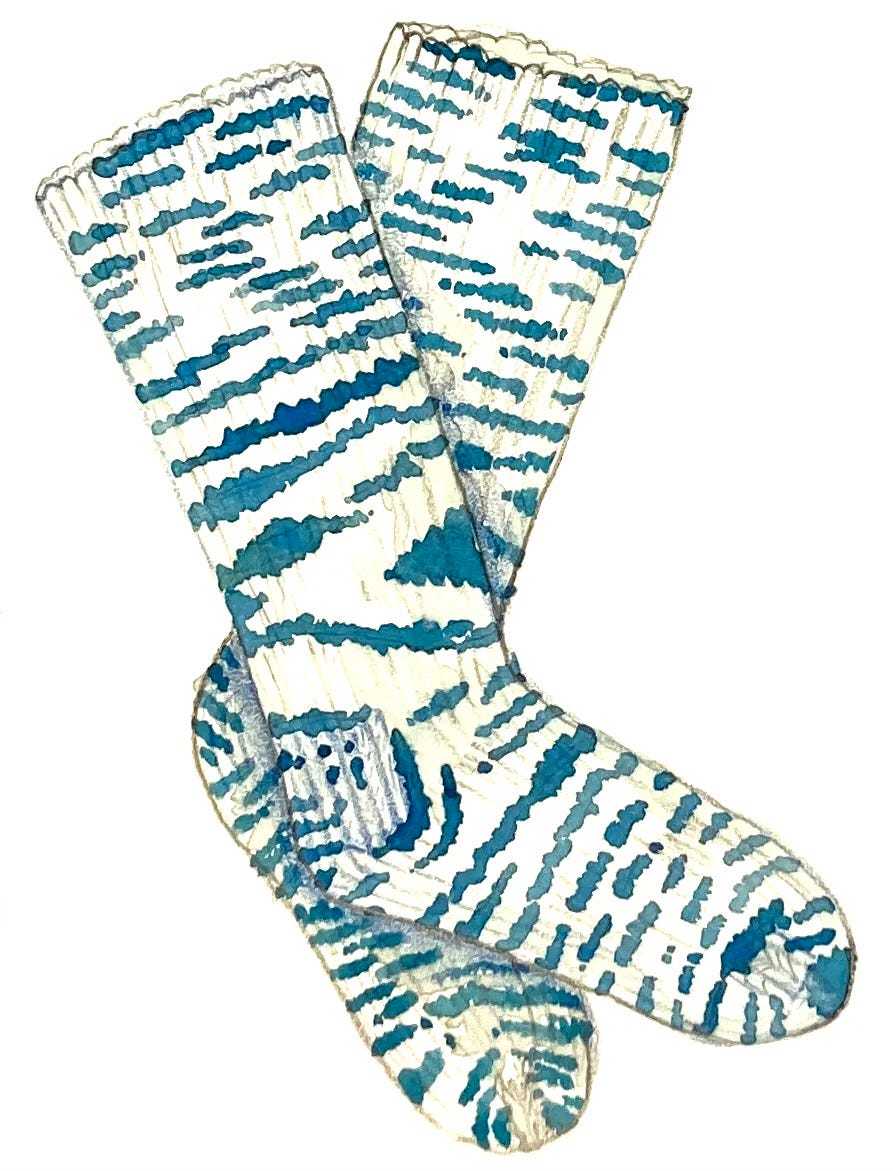
The comfort of knitting for me was not in the soothing repetitive movements and wooly yarn threading through my fingers. Though I did enjoy that. Knitting comforted me because it engaged my mind. Looping stitches put life back in order. And then I could sleep, as my Danish grandmother had taught me when she first placed knitting needles in my small hands.
Learning new ways of knitting—knitted lace, stranded knitting, steeking, alternative cast ons— always opened doors to new challenges. For comfort knitting, I chose to use a mathematical sock template, simplified yet engaging. The signature feature of my knitted socks was the picot cuff.[1] I knit one sock a week and keep friends and family supplied for years.[2]
Over time, knitting connected me with other faculty and administrators.
At a committee meeting—Faculty Affairs or Post-Tenure Review or some such—an email from the university provost popped up on my laptop. The committee chair was bemoaning the difficulty of scheduling a meeting with the provost. Provost was a powerful position, the chief academic officer who allocated campus priorities, second only to the president. To paraphrase:
Susan, I am knitting a scarf for my daughter and my stitching does not look right. Can you meet tomorrow and help me out? Lunch is on me at Jim & Pete’s. I’ll drive.
Was she kidding? Every day I grabbed a quick lunch, sometimes dinner, from my office minifridge and microwave. Lunch at a restaurant was a holiday. I imagined the committee chair seeing me with the provost and asking himself, How did she get an appointment with the provost?
Knitting also brought social connection within the village where I lived. A knitwear designer who accepted fashion design interns from our department invited me to join a knitting group that met Sunday afternoons. That group became my off-campus social anchor. Sometimes we took the El (elevated train) into the city for a yarn crawl or an occasional posh holiday tea at Marshall Field’s or The Peninsula.
I was settling into my new life.
But early on a Thursday morning in March came the phone call that my mother had died. She was in her nineties. Still, it was a shock. I had been with her in Nebraska on my move to Chicago and for Christmas. We had talked on the phone every week. One of my cousins offered to keep me company on the long drive back to arrange her funeral. I tossed clothes into a bag, stopped at the bank to make necessary financial preparations, and hurried to campus to ask the dean to cancel my next Friday and Monday classes. A good person, he offered to initiate a prayer chain. I told him no. What I needed from him was my own office and a stable classroom.
My cousin and I made the long drive to Nebraska, arranged the funeral over the weekend, and returned to Chicago on Monday night. No time for emotions, clearing her house, navigating financial responsibilities.
I was standing in front of my history of dress class at 8:30 Tuesday morning. I explained that my mother had died. Students moaned in sympathy, some with tears in their eyes. “Why don’t you just assign us more reading and go home and sleep,” said one of the more outspoken students.
I choked a little, feeling surprised and very touched. “Look, I’m here,” I said. “Everything’s ready. Let’s stick with the syllabus.” I turned to my PowerPoint presentation on Civil War-era clothing and why the wire hoop skirt had proven a liberating undergarment for women. After class, I walked upstairs to my newly assigned third floor office, a former music practice room with a door, a casement window, and walls that reached the ceiling, It was heaven.
I learned my department would soon have a designated classroom, newly refurbished.
Given my new quiet space, I carved out ways to learn about the larger university. The Candle and Rose Ceremony, a long-standing tradition, was held before each spring commencement. Graduating seniors, or “Candles,” carried lighted candles in a procession along a walkway to a wide lawn where they met their “Roses,” the undergraduate each had chosen. Seniors passed their candles, symbols of knowledge, to Roses. Undergraduates passed roses, symbols of compassion, to Candles. Candles reminded undergraduates to value knowledge, and Roses reminded graduating seniors to use their knowledge with compassion.
The university stood firm on social issues, and I joined a campus protest. An organization infamous for disrupting gay and lesbian events, even funerals, had notified the university they would protest The Laramie Project, a play staged on campus about the murder of Matthew Shepard, a gay student. The day of the protest, white vans disgorged a dozen or so sullen people, even small children, who carried hateful signs on the street in front of campus.
We were ready. Trained counter-protestors—faculty, staff, students, the Sisters, deans, vice-presidents, the president—joined hands and formed a series of lines. We stood in silence with our backs to the protestors, a human barrier between hate and intellectual freedom. With temperatures well below zero and snow on the ground, in a short while, the protestors piled back into their vans and sped off.
The Laramie Project went on as planned, well attended.
In early May, my first year of teaching ended. Wearing my Medieval costume to commencement, I watched my first seniors graduate. My reward for having made it this far was two weeks of travel and textile collecting in Uzbekistan (Tashkent, Fergana, Samarkand, Bukhara, Khiva) long planned with three other textile enthusiasts. I returned to face the challenge of writing 70,000 words about knitting history. “Information about the history of hand knitting in the United States is hard to find,” wrote much-admired author Bishop Richard Rutt in A History of Hand Knitting. Given the internet age and access to the seventh floor of bound periodicals at the Seattle Central Library, scarce information about knitting would not be my problem.
I tossed my laptop and research materials into my Toyota and headed to the Pacific Northwest, where my son had settled, for a summer of research and writing. I stopped for a week to clear my mother’s house, arrange to sell her home in a small town where no homes had sold for more than two years, and find a lawyer to settle her financial matters. With no will or other legal documents, that would take another year.
Back on the road, I continued across Nebraska and Wyoming, with a dip into Colorado, then back toward Montana and Idaho to Washington. I stayed with friends here and there and explored every knitting shop along the way.
My stash of colorful fingering-weight yarn grew and would see me through my next year of students and teaching, writing and sock knitting.
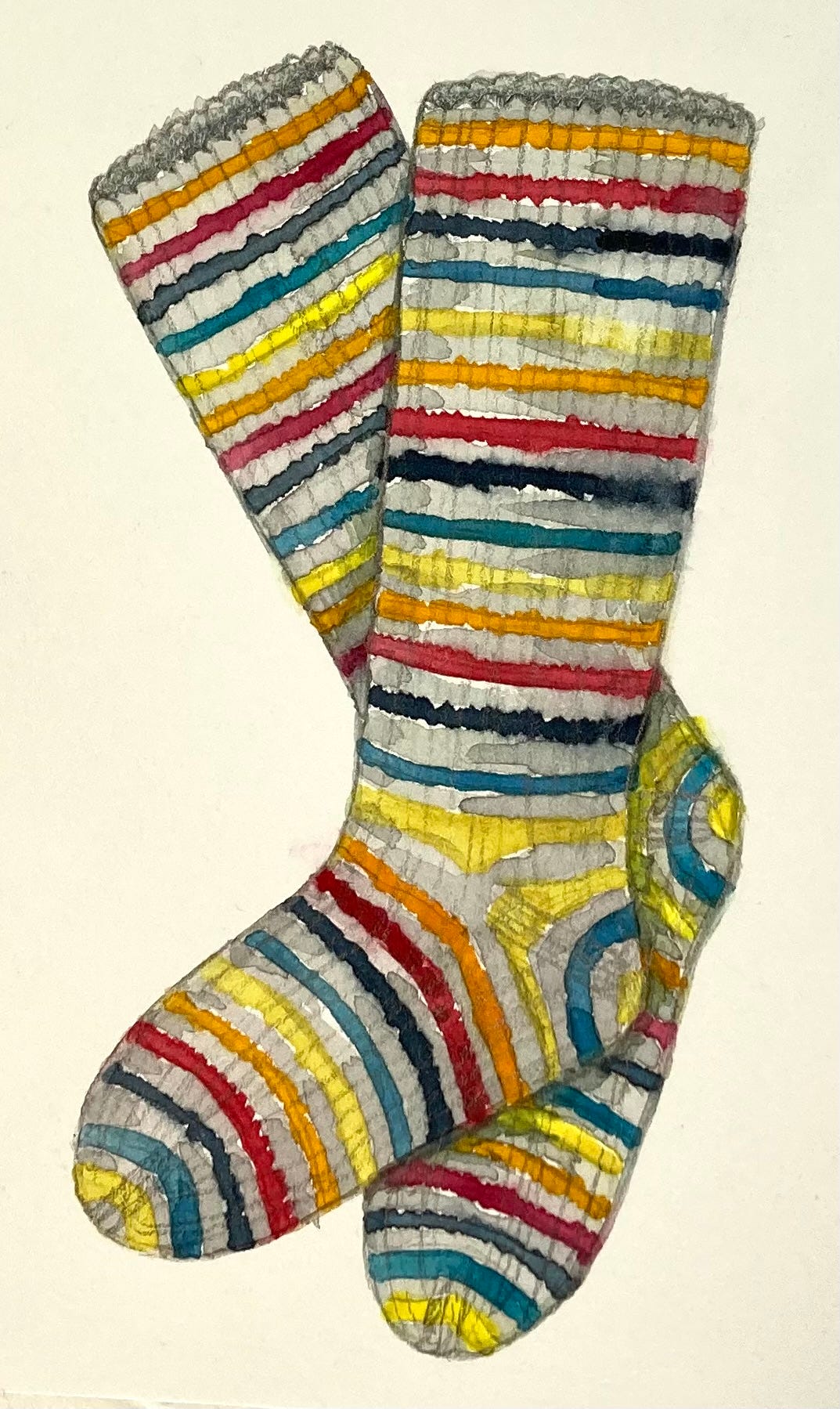
[1] I cast on an even number of stitches, joined into a round, and knit one inch in stockinette stitch. I worked one round of knit-two-together, yarn-overs (YO, K2TOG), then knit another inch of stockinette. I knit together the cast-on edge with the body of the sock. The pretty picot edge eliminated the rib knitting (knit one, purl 1) that I disliked.
[2] After the cuff, I decreased a set number of stitches toward the ankle. Colorful space-dyed yarn I knit in stockinette stitch and solid colors I adapted designs from Barbara Walker’s Treasury of Knitting Patterns. At the top of the heel, I divided stitches in half, knit slip one/knit one for the heel on one half, picked up gusset stitches, and continued to knit around for the length of my foot (sometimes this involved decreases). I varied toe shaping for variety.
Love this! Knitting saves another soul! I met you years ago in the Seattle Central Library Genealogy section. Both of us named Susan, both knitters, both genealogy enthusiasts and me exclaiming, when you told me you had written Knitting America, "you are FAMOUS". I am so thankful to be reading your substack posts each time you write them. Keep going!
Your class sounds fabulous. How fortunate your students were!