
The Knitted Crossing Flag
During winters in Chicago, my thoughts drifted to summers in Seattle and the Scandiuzzi Writers Room on the ninth floor of the Seattle Central Library.

Seattle, Washington
Summers 2005-2014
Winters in Chicago tested my mettle.
Temperatures hovered below freezing. Scattered snowflakes could turn into white curtains within minutes, blurring sidewalks, streets, and lawns. Winds drove snow horizontal and into serious drifts. An army of snowplows took to the streets.
Alone in my office, bundled in a wool sweater, I stared at the ice, thick and lacy, that coated my casement window. At such times, my thoughts drifted, not to Maui or Cuernavaca or Palm Springs, but to my upcoming summer in Seattle and views of Puget Sound from the Eulalie and Carlo Scandiuzzi Writer’s Room on Level Nine of the Seattle Central Library.
Spring arrived, and my first year of university life ended. On the last day of class, one of my students peered around my office door.
“Have a minute?” she asked. She came in and sat down.
“I really don’t exist,” she said.
I swiveled my chair to face her. We connected eye to eye.
“Someone with my background does not have my life,” she said.
I knew she was an electrical engineer, married with three children, and had completed her first year as a fashion design student.
“My mother raised me on her own on the wrong side of Baltimore. My father left when I was a baby. Mom made sure education came first. I met my husband in college. He’s also an electrical engineer.”
“Impressive,” I said.
“My mother and I were always sewing or knitting. I loved that, but she said it wasn’t practical for a career” She leaned closer. “My husband’s job is going well, our kids are in school, and last year we decided it was time for me to follow my heart and study fashion design.”
“You certainly have succeeded,” I said. I paused to collect my thoughts. “May I ask you a question?”
“Sure.”
“I’m researching the history of American knitting for a book. In 1967, for the first time, I found a knitting pattern book with a Black model, a little girl wearing a stylish knitted coat and hat.” [1]
She nodded.
“That’s just three years after passage of the Civil Rights Act of 1964. Before then, I never see Black people as models or as knitters, for that matter. Really, you’d think older white women were the only knitters in the world. What was that like for you and your mom?”
“We knew that wasn’t right,” she said. “Magazines and pattern books never showed Black people. It was like we didn’t exist. It wasn’t right.”
Apparently, the solution had required an act of Congress.
Encouraged by the conversation with my student, I decided to look for knitting across age, gender, class, race, nationality, and ethnicity during my summer research. I would search page by page through the collection of relevant nineteenth- and twentieth-century bound periodicals that filled the seventh floor of the Seattle Central Library.
I loaded box after box of resources into my car for the road trip west: reference books, vintage periodicals, hard copies of research to date. I relied heavily on digital resources, especially emails and photos from generous archivists, curators, and librarians at such institutions as the Mount Vernon Ladies Association, Daughters of Utah Pioneers Museum, Japanese American National Museum in San Diego, Daughters of the American Revolution Museum, National Museum of American History at the Smithsonian Institution, Burke Museum of Natural History and Culture, and many state historical societies. I had also discovered a wealth of information on knitting at the American Memory site, the digitized primary source on American history and culture from the Library of Congress. But I decided to go old school—hard copies and index cards—to organize topics and chapters.
Eastern Nebraska was my first stop along the drive. I had to clear my mother’s house, then find a lawyer to settle her affairs and a real estate agent to sell the property in a town where no homes had sold for two years. (But that is another story for another time.)
After that, I savored short stays with nurturing friends and relatives in Iowa, Nebraska, Colorado, and Idaho on my way to the Pacific Northwest.
Driving on my own that first summer and the next nine summers, I poked into whatever places struck my fancy. I stayed overnight at Little America in Wyoming, toured the Brown Sheep mill in Nebraska, tromped around the Little Big Horn Battlefield in Montana, explored the Corn Palace in South Dakota, meandered through the antique village of Walnut in Iowa, walked coastal beaches in Oregon, and pulled over to savor regional yarn shops. Crazy Woman Yarns in Des Moines, Iowa. Cowgirl Yarns in Laramie, Wyoming (“We’ll you’re your balls”). Skeins in John Day, Oregon (fishermen came in looking for fish bait). Joseph’s Coat in Missoula, Montana, where the extraordinary Susanna Springer became my friend (another story for another time).
During my first two Pacific Northwest summers, I rented a carriage house in the woods across Puget Sound near the town of Port Orchard. In subsequent years, I stayed in apartments near downtown Seattle: the Chinatown-International District, the Norwegian enclave of Ballard, Queen Anne Hill, Sand Point on Lake Washington, historic First Hill near Seattle University, and across Puget Sound on Bainbridge Island.
My first summer in the woods near Port Orchard, I knew no one except my son. He lived and worked in Seattle. The solitary life of academia and writing had taken me by surprise, but I accepted and expected it as part of the experience. How strange that being alone was essential for the work I had chosen, work with the goal, at its core, of taking part in large conversations.
On library days, I took the “foot ferry” (passengers only) to Seattle. I loved knitting on the boat (boat, not ferry, in the local vernacular).
“What are you knitting?” asked a pleasant young woman who was knitting with other commuters on the boat. We chatted a while, admiring the view of Mount Rainier across the Sound. She was a nurse in the burn unit at Harborview Medical Center, the hospital that had inspired the new medical drama, “Gray’s Anatomy.”
“You should join us,” she said. “We meet at Sharon’s house in Port Orchard on Wednesdays at 7:00.”
And just like that, I had friends.
One evening, our little group sat knitting atop a boat that a knitter’s husband skippered on the water near Naval Base Kitsap, a large Navy installation and home to aircraft carriers, submarines, and a shipyard. Very small Coast Guard or Navy boats—nimble and well-armed for security—hovered nearby.
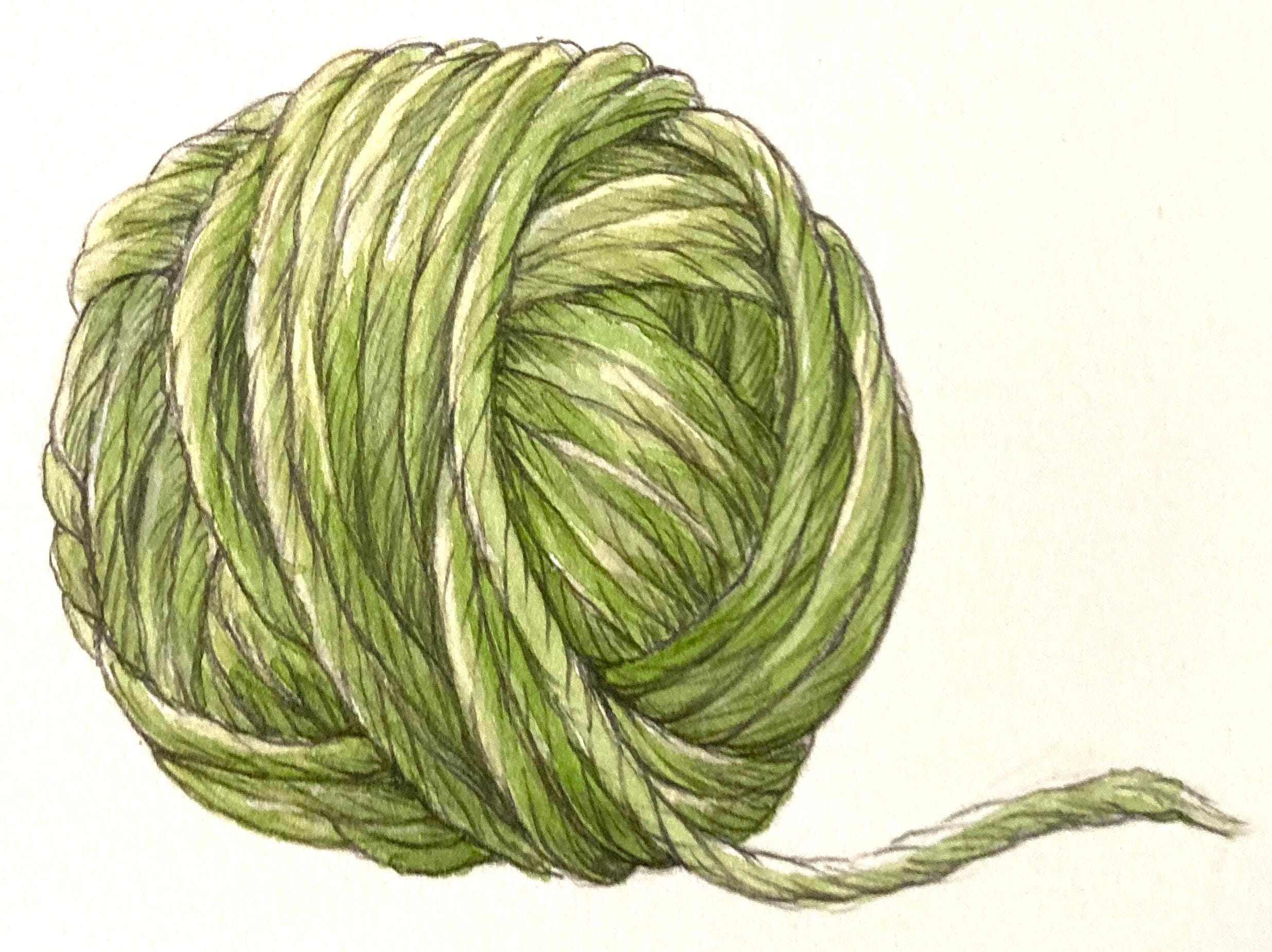
“Do you think the security guys are watching us?” I asked. I imagined their conversation: “That boat, the one with women holding sharp sticks,” they said. “What are they doing?” I laughed and dropped my ball of yarn. We all rushed to grab the yarn, but in a second it had rolled overboard. Our skipper shouted, “Watch out when you pull that yarn up. The water is full of jellyfish. They sting!”
Depending on where I was staying any particular summer, most days I took the ferry or bus or light rail to the base of the steep hill leading to the full city block occupied by the library.
The Seattle Central Library had opened its doors on May 23, 2004.
The massive floating platforms of clear glass stacked at startling angles eleven stories high and wrapped in an immense steel net was the innovation of Dutch architect Rem Koolhaas. The architecture critic for the Seattle Post-Intelligencer found the building “confusing, impersonal, uncomfortable, oppressive” with features “decidedly unpleasant” and “profoundly dreary and depressing.” Architect Ruth Conroy Dalton considered the library so befuddling that she wrote a book dedicated to its confusing layout. In contrast, Pulitzer Prize-winning journalist Paul Goldberge wrote in The New Yorker, “[The Seattle Central Library] is the most important new library to be built in a generation, and the most exhilarating.”
I loved the Seattle Central Library.
Mornings before 10:00, I gathered outside the revolving doors with au pairs pushing tots in strollers, tired-looking men and women hefting duffel bags, and a few white-collar businesspersons. Inside, I entered an M. C. Escher surrealistic space filled with escalators and stairwells, doorways and elevators, and a four-story continuous spiral with millions of books. First, the escalator with poison green side rails lifted me to the floor with a coffee kiosk, where baristas asked, “The usual?” Coffee in hand, I glided up another escalator with egg-yolk yellow side rails beside a sculpture with talking ovals cut into the wall, and then onto another escalator or an elevator to the ninth floor and the Eulalie and Carlo Scandiuzzi Writers’ Room.
I had requested access and became a summer regular in Scandiuzzi, so I punched in the key code and set up my laptop on one of six desks. Some days, I sat and read in the Eames lounge chair beside glass walls with views of Seattle and Puget Sound. I could leave books at my desk, place my laptop in a locker, and return after, say, hearing a librarian read “Thrilling Tales” in the Microsoft Auditorium or meeting my son for lunch in Pioneer Square.
Interestingly, Scandiuzzi had no ceiling. The space overhead was open to the Level Ten map room and to shouts of tourists who stepped out of the elevators to exclaim over the stunning views. “Wow, look at that!” “Can you believe this view?” Sounds kept me alert, focused. Other writers, maybe not. Often, I had the room to myself.
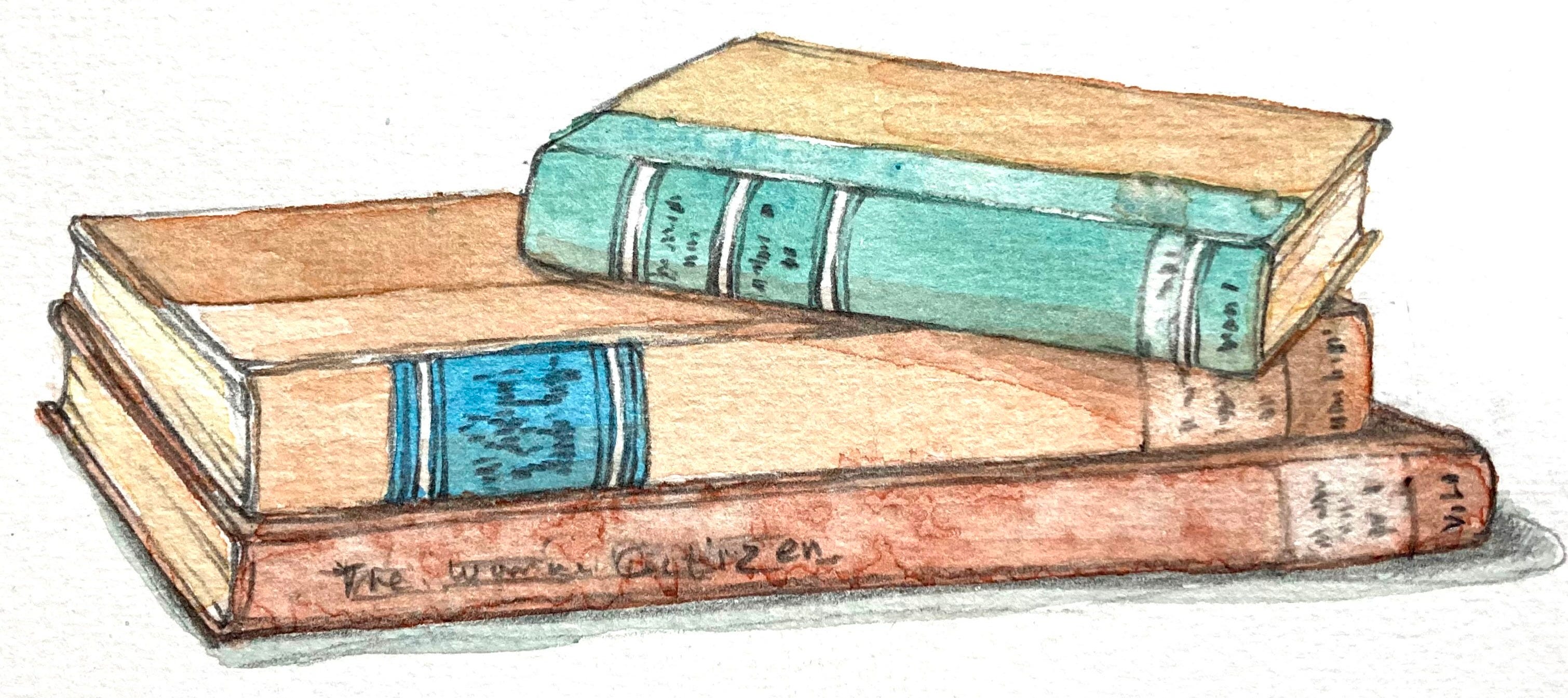
Each day, I carried bound periodicals, oversized and heavy, from the seventh floor to my desk and searched page by page through niche publications looking for articles and images about knitting. Some searches were driven by intuition—checking the index in Godey’s Lady’s Book, for example—but many finds were serendipitous. I spotted the suffragist periodical, The Woman Citizen, on the shelf and discovered stories of suffragist knitters during World War I. The library’s Art Files, thousands of pages cut from magazines, included folders for knitting, sweaters, and crafts.
A steady diet of writing can be lonely, so I looked for knitters the first summer I stayed in Seattle. On National Knit in Public Day, I met knitters who invited me to a group that met in a bookstore on Thursday mornings. One evening, I dropped in at a yarn shop and listened quietly to conversations, wide-ranging and offbeat, in a knitting group. They had food and wine.
The following week, I returned. The knitters stared at me in silence. “You came back,” said one, finally. “People don’t usually come back.”
“I liked listening to you,” I said. “This group will never be boring.” I returned every summer. Now I had friends on both sides of Puget Sound.
Besides the never-boring conversations, I like their theme nights. Like Jell-O night, when we shared childhood food and memories. Like when one member knitted twenty hats for her mother, who was undergoing chemotherapy, and others in the group knitted squares to assemble into a comfort blanket for her, a caring daughter. Or like the surprise baby shower.
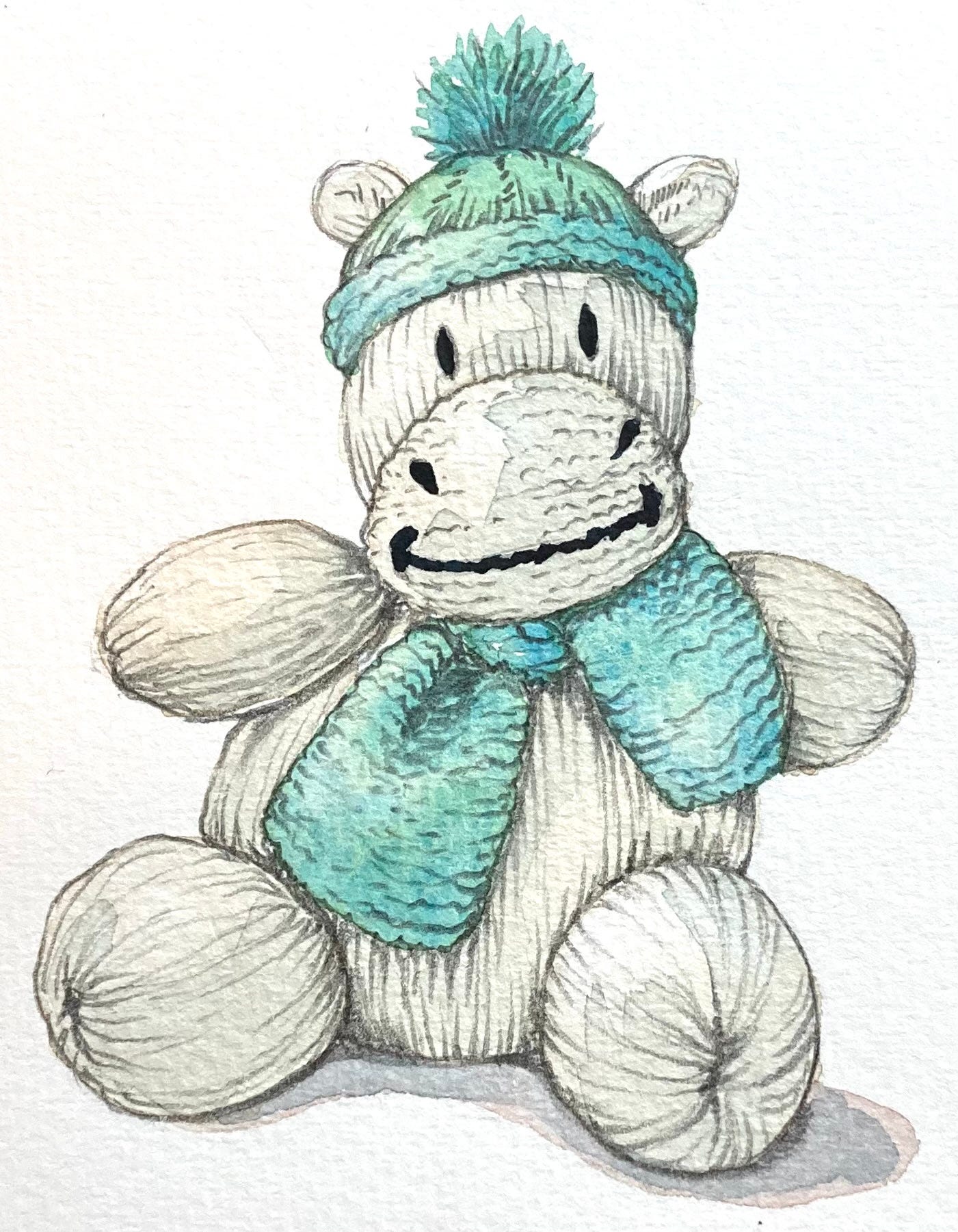
For weeks, on the sly, we had knit blankets, tiny clothes, and toys in the pregnant knitter’s colors (gray and turquoise, as I recall). One evening, she came for knitting and walked into a party with all our hand knits arranged along the table. Among the knits were the tiniest Fair Isle cardigan and a hippo in scarf and beanie (that was mine). My hippo was so uber-cute and sweet that it made my teeth ache. The baby loved it (the mom told me later).
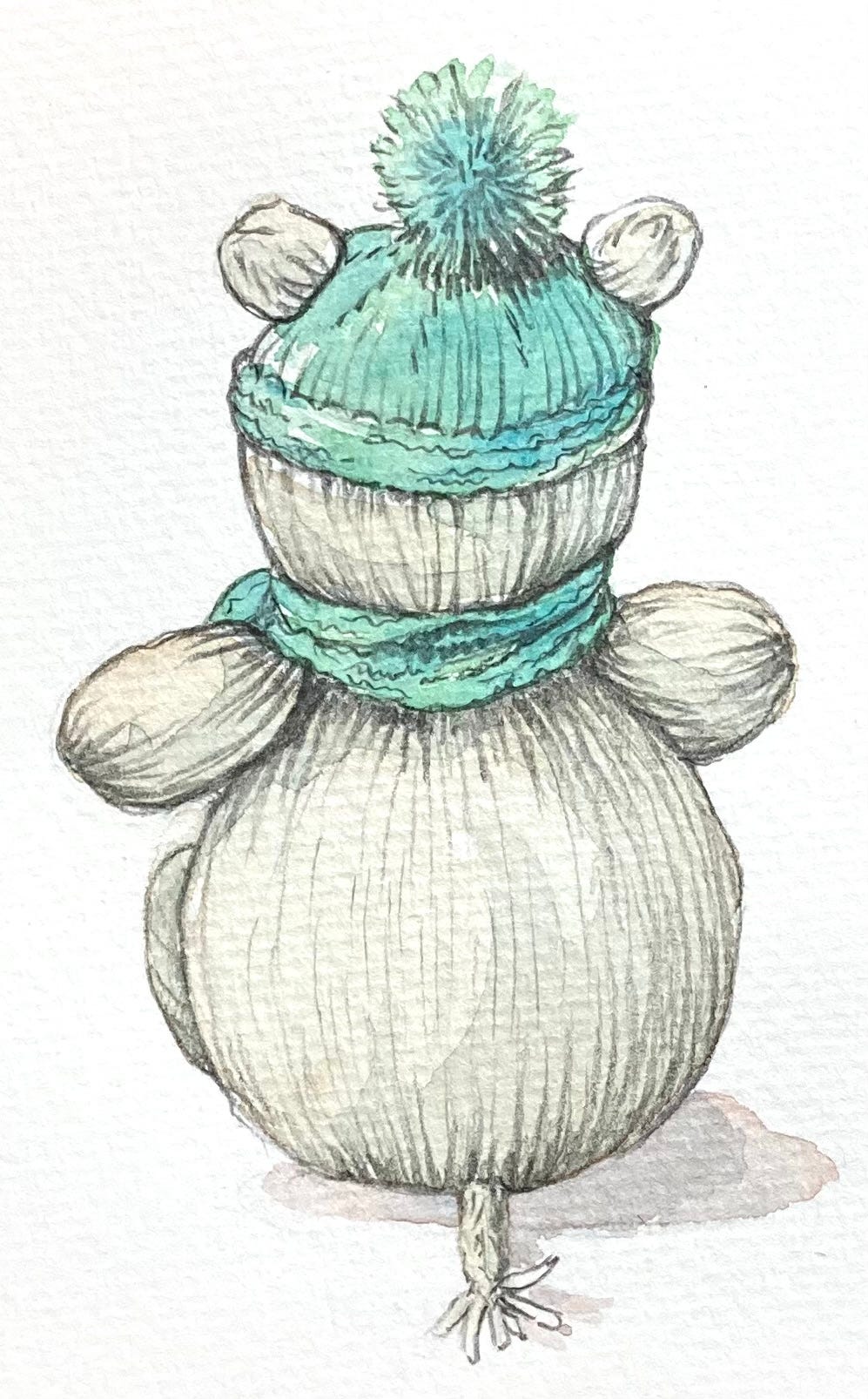
Another night, we yarn bombed the neighborhood, a busy suburban street lined with tall trees and independent shops. Yarn bombing was great for using up stash.
“Here’s a basket of free yarn for your yarn bombs,” announced the shop owner one evening. I pulled out one skein each of neon yellow and neon green.
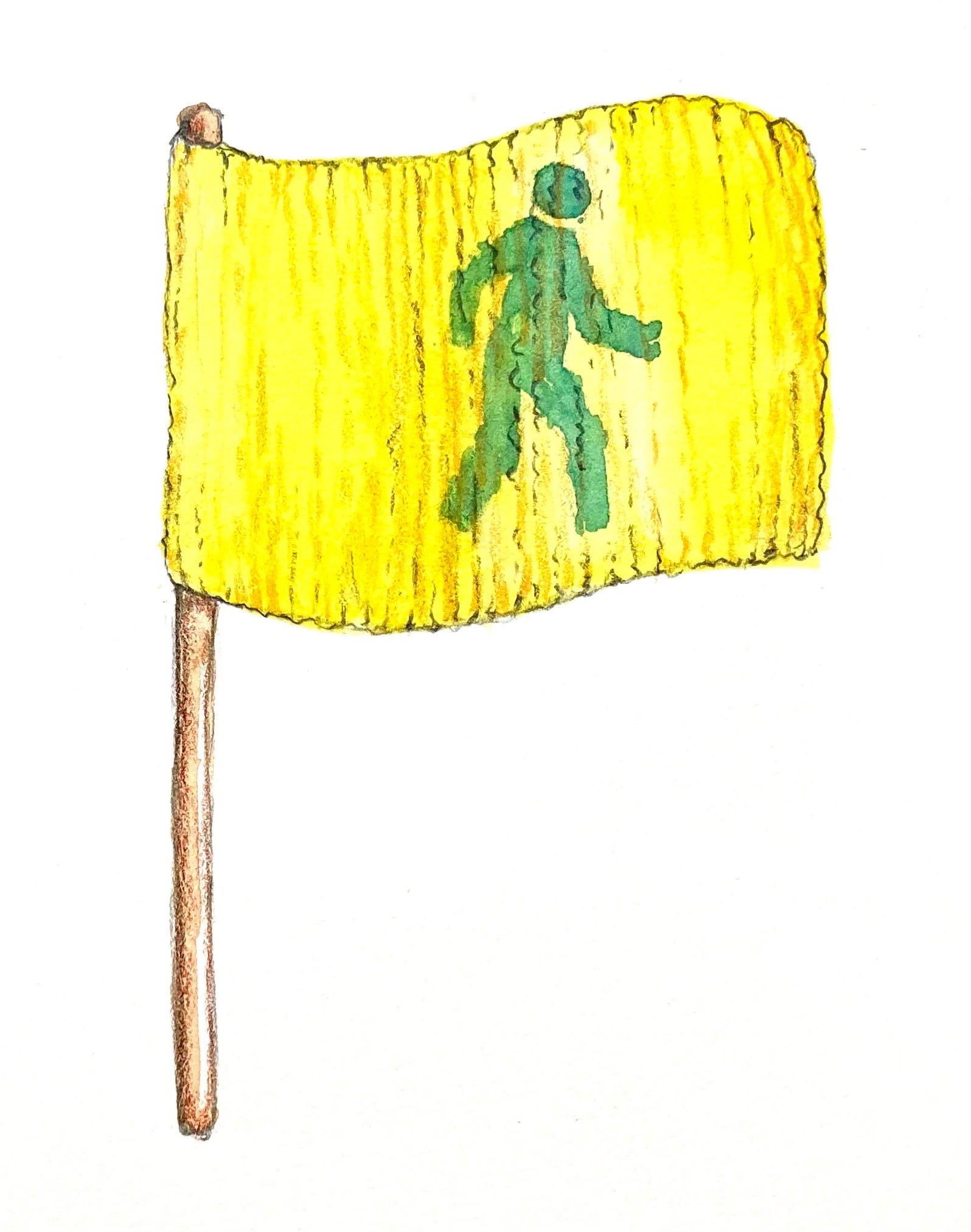
A crossing flag! I thought. Perfect for the bin at that crosswalk down the street.
“No one wants these neon yarns, right?” I asked. Neon was no longer trending. I intarsia-knitted a green pedestrian logo on a yellow background and stapled my flag onto a hardware-store dowel. On yarn bombing night, we wrapped brightly striped sweaters around tree trunks, strung prayer flags across branches, placed a cunning knitted fire hydrant in front of the fire station, and I placed my flag in the bin beside the crosswalk.
Strolling with the group toward the neighborhood pub, I saw a pedestrian lift my knitted flag from the bin. He rubbed his hand over the fabric, glanced with raised eyebrows toward his friends, shrugged, and crossed the street waving the flag. He placed it in the bin on the other side of the street. They were laughing and smiling.
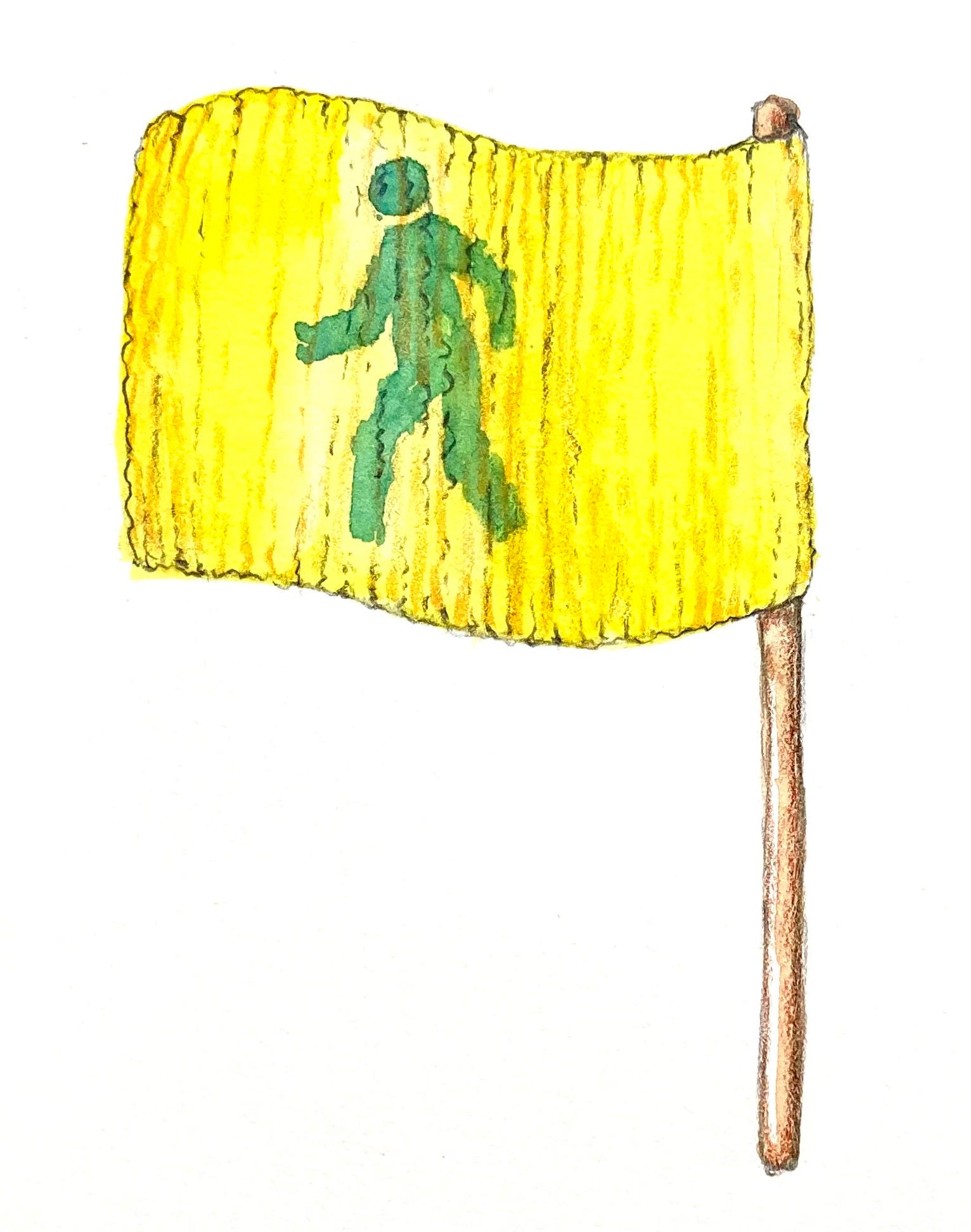
“Look,” I shouted. “Someone picked up my flag!” Seldom had I felt prouder of my knitting. Three days later, my flag went home with an anonymous pedestrian.
For ten summers, the Eulalie and Carlo Scandiuzzi Writers’ Room was my home for research and writing during most weekdays and weekends. During the first summer, I worked on my knitting history book. [2] Searching bound periodicals, I found photos and stories of knitters—predictably skewed female, white, and older—but when I looked page by page, American knitters were also there across age, gender, class, nationality, ethnicity, and even politics.
After that first year, I wrote papers required for academic promotion, but also to satisfy my curiosity about stories in textiles, especially knitting. I embraced each story, from the humble knitted baby soaker to the politicized Mexican tourist jacket, from pathos in an unfinished World War II knitted Red Cross sweater to the historical significance of Corticelli silk thread. I would finish one story, and the next story would present itself. I had never felt happier.
Each year in mid-August, Pacific Northwest blackberries, wild and invasive, began to ripen from green to red to luscious black. Feral blackberries lined waterfront trails, city slicker blackberries grew with wild abandon along streets, sly blackberries crept between the slats of garden fences. Aggressive shoots eight feet long, thick as my thumb and covered with thorns, shot from thickets.
Ripening blackberries meant it was time to return to Chicago for the next academic year.
I drove east in hope of milder winters.
But I bought more sock yarn along the way, just in case.
[1] “Little Red Riding Hood—Number 766-26,” (1967). Beautiful Baby Book: Infants to Four years. Columbia Minerva, 37.
[2] Knitting America: A glorious heritage from warm socks to high art. Minneapolis MN: Voyageur Press, 2007.
I love your writing and your illustrations, this one hit hard especially since I love Seattle and miss it but I scarcely remember the Seatle I love anymore because of tech encroaching upon most obvious remnants of culture :( this was a beautiful reminder of what has existed and still does exist
Regarding the student’s identity, how did she navigate it?